Occupational Exposure Calculations: The UK Construction Guide to Noise, HAVS and WBV
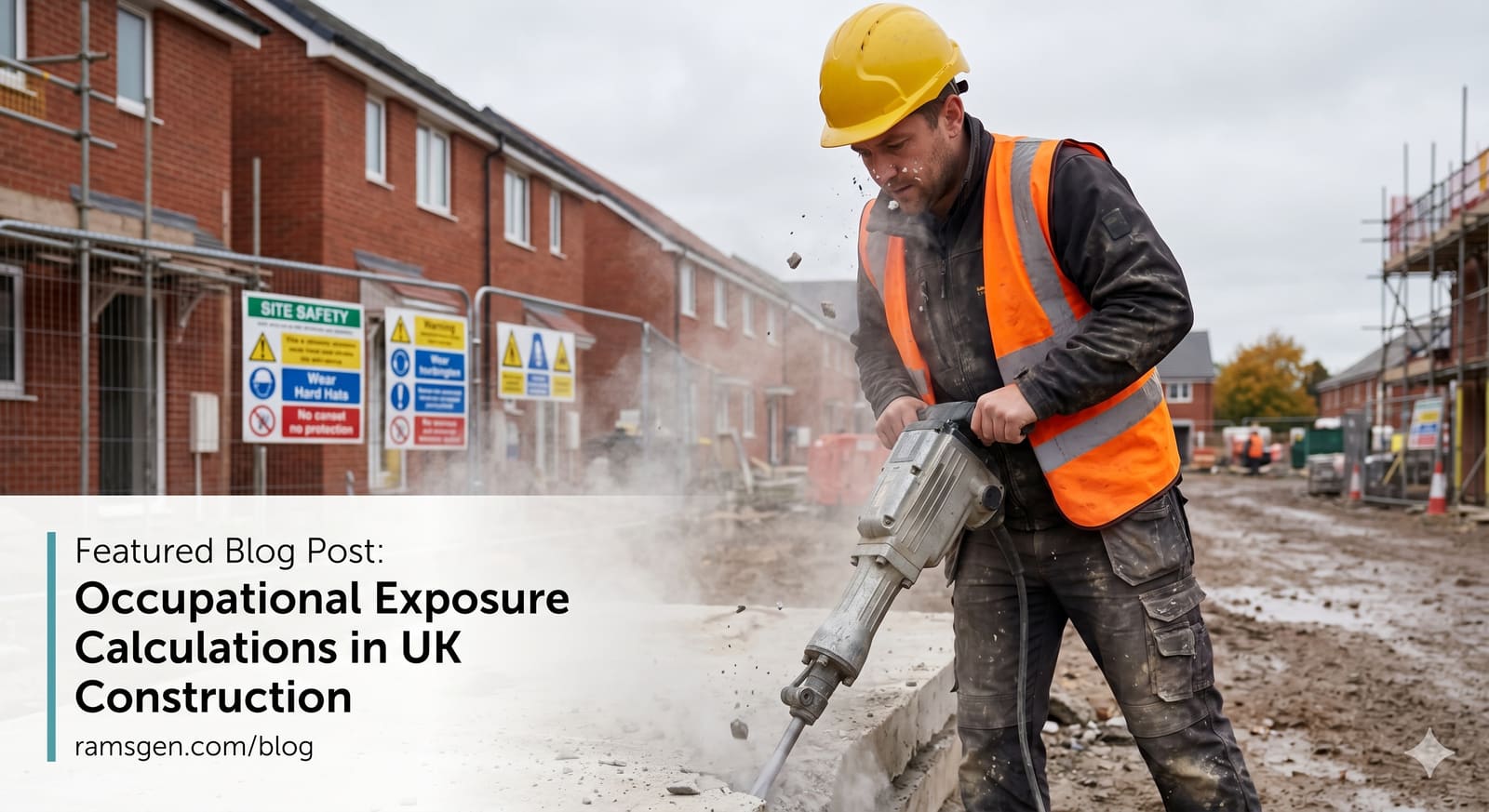
Occupational Exposure Calculations: The UK Construction Guide to Noise, HAVS and WBV
Most construction site fatalities make the headlines. The slow claims don't. The largest categories of compensable occupational ill-health in UK construction aren't falls or crush injuries — they're noise-induced hearing loss, hand-arm vibration syndrome (HAVS) and back damage from whole-body vibration. All three develop quietly over a decade or more. All three are entirely preventable. And all three sit under regulations that require you, as the employer, to calculate and record worker exposure — not just provide PPE and hope for the best.
Two pieces of legislation cover the lot: the Control of Noise at Work Regulations 2005 (CoNAWR) and the Control of Vibration at Work Regulations 2005 (CoVWR) — which covers both HAVS and WBV. Each uses different units, different thresholds and slightly different methodologies. They're easy to confuse and easy to get wrong.
This guide is your starting point. We've built three free calculators that handle the maths for you — HAVS, WBV and noise exposure — and the guides below walk through each method by hand if you want to understand what's going on under the bonnet.
Why occupational exposure calculations matter on UK sites
The HSE's most recent figures (2023, Industrial Injuries Disablement Benefit scheme) record 215 new cases of HAVS, 115 new cases of vibration-related carpal tunnel syndrome, and 100 new cases of occupational deafness assessed for compensation. The IIDB threshold for deafness is high — 50 dB or more of hearing loss in both ears — so it captures only the worst end of the curve. The Labour Force Survey, which counts self-reported cases, estimates around 12,000 workers in Great Britain currently living with work-related hearing problems.
Construction sits in the top three industries for new HAVS assessments year after year, alongside extraction and manufacturing. The vibration-exposed trades — scaffolders, groundworkers, demolition crews, plant operators, formworkers — are over-represented across every dataset.
The legal stakes are not theoretical:
- Improvement and prohibition notices under the HSWA 1974 are routinely issued where exposure assessments are missing or demonstrably wrong.
- Criminal prosecution is on the table for serious breaches. Where a worker has been diagnosed with HAVS or NIHL and the employer cannot produce a credible exposure calculation, the case usually settles before it gets to the dock — but at significant cost.
- Personal injury (PI) claims for occupational deafness and HAVS run into tens of thousands per claimant. Employers' Liability insurers will look for a contemporaneous exposure assessment when defending. If you don't have one, the defence collapses.
These calculations also feed directly into the rest of your safety management system. Exposure figures should appear in your Risk Assessments and Method Statements (RAMS), drive your health surveillance programme (audiometry, HAVS triage, lumbar assessment), and sit in your tool register alongside maintenance and PAT records. They are not standalone admin — they're the backbone of how you defend the work.
The three exposures you're legally required to assess
Noise exposure (Control of Noise at Work Regulations 2005)
Noise exposure is measured as daily personal exposure, LEP,d (or weekly, LEP,W), expressed in dB(A) — A-weighted decibels, filtered to match human hearing sensitivity. The figure is normalised to an eight-hour working day. "Normalisation" means that an hour at 91 dB(A) is treated as equivalent in dose to eight hours at 82 dB(A): the same total energy, the same damage.
CoNAWR 2005 defines three thresholds:
- Lower Exposure Action Value (LEAV): 80 dB(A) LEP,d/W, or 135 dB(C) peak. Hearing protection must be made available; workers must be informed and trained; the employer should consider health surveillance.
- Upper Exposure Action Value (UEAV): 85 dB(A) LEP,d/W, or 137 dB(C) peak. Hearing protection zones must be designated and signed; protection is mandatory in those zones; health surveillance is required.
- Exposure Limit Value (ELV): 87 dB(A), or 140 dB(C) peak. This is an absolute ceiling that must not be exceeded with hearing protection factored in. Unlike the action values, this is measured at the ear, with attenuation taken into account.
Peak pressure (LCpeak in dB(C)) is assessed separately from LEP,d. A single loud event — a cartridge tool, hammer-on-steel, an explosive bolt — can damage hearing instantly, even on a quiet day.
We go deep on the maths in our full guide to calculating noise exposure.
Hand-arm vibration (Control of Vibration at Work Regulations 2005)
HAVS is the headline injury for trades using vibrating hand tools — breakers, scabblers, grinders, impact wrenches, chainsaws, needle scalers. Vibration energy transmitted through the palms damages blood vessels, nerves and joints. The early signs are tingling, numbness and the cold-triggered finger blanching that gives vibration white finger its name. The late stages — loss of grip, permanent sensory loss, peripheral neuropathy — are irreversible.
The CoVWR 2005 measures HAVS exposure as A(8): the eight-hour time-weighted frequency-weighted vibration magnitude in m/s². Two thresholds apply:
- Exposure Action Value (EAV): 2.5 m/s² A(8). Trigger for risk reduction measures, health surveillance and information/training.
- Exposure Limit Value (ELV): 5.0 m/s² A(8). Absolute daily ceiling.
The HSE also publishes an exposure points system as an alternative to raw A(8) values. The conversion is fixed: 100 points = EAV (2.5 m/s²), 400 points = ELV (5.0 m/s²). Points are useful because they are additive — partial points for each tool can simply be summed — whereas A(8) values from multiple tools require a sum-of-squares calculation. In daily practice, points win on simplicity.
Read the full HAVS calculation walkthrough, including the HSE tool magnitude database.
Whole-body vibration (same regulations)
Whole-body vibration (WBV) affects workers seated or standing on vibrating plant — excavator operators, dumper drivers, ride-on rollers, forklift operators, HGV and agricultural drivers. The energy enters through the seat or feet rather than the hands, and the primary outcome is lower back and spinal disorder.
CoVWR 2005 provides two assessment methods for WBV, used independently:
- A(8) method. EAV is 0.5 m/s² A(8) (100 points). ELV is 1.15 m/s² A(8) (529 points — note: not 400). Use where vibration is reasonably continuous and regular.
- VDV method (Vibration Dose Value). Threshold is 17 m/s¹·⁷⁵, taken from ISO 2631-1:1997. Use where exposure contains significant shocks and jolts — rough ground, broken-out concrete, off-road forklifts — because the RMS-based A(8) method tends to underestimate impulsive vibration.
WBV is measured on three axes (x — fore-aft, y — lateral, z — vertical) and the highest axis figure is what counts. Importantly, the horizontal axes (x and y) are multiplied by a k-factor of 1.4 before comparison, because horizontal vibration causes proportionally more spinal damage at the same magnitude. The vertical axis (z) takes a k-factor of 1.0. Forgetting the k-factor — or applying it twice when the manufacturer's data already includes it — is the most common error in manual WBV assessments.
Our step-by-step WBV calculation guide covers both A(8) and VDV methods.
How the three calculations relate to each other
The three regulations look very different on the page, but they share three structural features that, once you see them, make everything easier to remember.
1. All three normalise to a reference period. A(8) and LEP,d both normalise to an 8-hour reference day. LEP,W normalises to a 5-day reference week. The maths assumes equal-energy: half the time at twice the dose is the same total exposure.
2. All three offer a points system as an alternative to the raw magnitude. Points are additive across tasks within a day; the underlying units (m/s², dB(A)) are not. The reference points differ:
| Calculator | Action value (points) | Limit value (points) | Reference |
|---|---|---|---|
| Noise (CoNAWR 2005) | 31.62 (LEAV) / 100 (UEAV) | 158.49 (ELV) | 100 points = 85 dB(A) UEAV |
| HAVS (CoVWR 2005) | 100 | 400 | 100 points = 2.5 m/s² EAV |
| WBV A(8) (CoVWR 2005) | 100 | 529 | 100 points = 0.5 m/s² EAV |
| WBV VDV (CoVWR 2005) | — | 17 m/s¹·⁷⁵ (ISO threshold) | No points system |
A few traps to flag in that table. WBV's ELV is 529 points, not 400 — the ratio of ELV to EAV is different from HAVS, so the scaling differs. Noise's reference point of 100 corresponds to the UEAV (85 dB), not the ELV (87 dB) — the ELV in points is 158.49.
3. All three are task-based. You calculate exposure per task or tool, then aggregate over the working day. A worker who uses a 9-inch grinder for an hour and a breaker for forty minutes has a partial exposure from each, and the two are combined to give the daily total. The combination method differs between the calculators (sum-of-squares for A(8), simple addition for points, logarithmic for noise dB) — but the principle is the same.
Get those three patterns into your head and the rest of the work is bookkeeping.
Free calculators (RAMSGen tools)
We've rebuilt the HSE Excel calculators as proper web tools — no downloads, no version drift, no formulas that get accidentally overwritten when a colleague edits the file. Each tool produces an output you can save as a PDF exposure record and attach to your RAMS or health surveillance file.
HAVS exposure calculator
Calculate A(8) and exposure points for any combination of tools and durations, with the HSE recommended magnitude library built in. Pre-loaded with the standard HSE tool list — drills, grinders, breakers, scabblers, chainsaws, impact wrenches and the rest — so you don't have to guess at magnitudes for routine tools. Enter a custom ahv value where you've got measured data.
Whole body vibration calculator
Both A(8) and VDV methods in one tool. K-factors handled automatically, with a flag to toggle off where your source data already includes them (a frequent source of double-counting errors). Three-axis input, highest-axis logic, and time-to-EAV / time-to-ELV displayed for every operation.
Noise exposure calculator
Daily (LEP,d) and weekly (LEP,W) exposure in one tool. Add as many task rows as you like — we'll sum the exposure points and tell you which action value zone you're in. Includes the protected-level calculator for hearing protectors (SNR, HML and octave-band methods) so you can check whether the protection in use is adequate.
From calculator to compliance: what comes next
Getting a number out of a calculator is the start, not the finish. A calculated A(8) of 4.8 m/s² is not, in itself, evidence of compliance — it's evidence that you need to do something about it.
The hierarchy of control under both CoNAWR and CoVWR is the same as everywhere else in UK health and safety law:
- Eliminate — can the work be done without the noisy or vibrating tool at all? Remote-controlled demolition, hydraulic splitters instead of breakers, factory-cut sections instead of on-site cutting.
- Reduce at source — quieter equipment, vibration-reduced models, well-maintained plant. Manufacturer ratings vary wildly within a tool category; the difference between a vib-reduced breaker and a standard one can be 10 m/s² or more.
- Engineering and administrative controls — job rotation, exposure caps per worker per day, scheduling noisy work for periods when fewer workers are exposed, designated hearing protection zones.
- PPE — always last, never first. Hearing protectors and anti-vibration gloves are the final line, not the default.
The calculation feeds three places in your wider system:
- RAMS. Every method statement that includes a vibrating tool or high-noise activity should reference the calculated exposure figure for that task and the controls in place.
- Health surveillance. Triggered at the UEAV for noise (audiometry) and the EAV for vibration (HAVS triage by an occupational health provider). The exposure calculation defines who is in scope.
- Tool register. Each piece of equipment should carry its vibration magnitude (HSE value or measured) and, for noise, its declared LWA or LpA. A tool register that doesn't include this data can't support a defensible exposure assessment.
If you're building this into formal documentation, our RAMS authoring platform generates compliant Method Statements and Risk Assessments that reference these exposure calculations directly — the same numbers flow through from the calculator into the RAMS without re-entry.
FAQs
What's the difference between EAV and ELV?
The Exposure Action Value (EAV) is the threshold at which control measures, training and (in most cases) health surveillance become legally required. The Exposure Limit Value (ELV) is an absolute daily ceiling that must not be exceeded. For noise, the ELV is measured at the ear with hearing protection attenuation taken into account; for vibration, it's measured before any PPE. Being below the ELV is not the same as compliance — you still have to manage everything between the EAV and the ELV.
Do I need to do these calculations for every individual worker?
In principle, yes — exposure is personal. In practice, where workers in the same role do the same task mix, you can calculate a representative assessment for the role and apply it to everyone in that role, provided you document the assumptions. Where one worker's pattern is materially different (a foreman who only occasionally uses tools, for example), they need their own assessment.
How often should I recalculate exposure?
Recalculate when the task mix changes, when new equipment is introduced, when health surveillance flags an emerging case, and at minimum as part of an annual review. Site-specific RAMS should reference the assessment current at the time of the work — not last year's figure for a different project.
Can I use manufacturer's data instead of measured values?
For starting-point assessments, yes. Manufacturer-declared vibration magnitudes (under EN ISO standards) and declared noise levels are an acceptable input. However, declared values are taken under idealised test conditions and routinely underestimate real-world exposure — sometimes by a factor of two or more. The HSE explicitly recommends that where exposure is close to or above the EAV, the assessment should be supported by site measurement. The HSE tool magnitude database (used in our HAVS calculator) is generally more conservative than manufacturer data and is a safer starting point.
What records do I need to keep under HSE rules?
The assessment itself, the calculation supporting it, the control measures implemented, PPE issued, training provided and health surveillance records. There is no fixed statutory retention period for the assessment, but health surveillance records must be kept for 40 years under the COSHH equivalent timeline that the HSE recommends for noise and vibration. In practice, treat all of this as effectively permanent — claims for HAVS and NIHL routinely arise decades after the original exposure.
How does this relate to health surveillance?
Health surveillance is triggered by exposure level. For noise, audiometry is required for anyone regularly exposed at or above the UEAV (85 dB(A) LEP,d). For vibration, HAVS health surveillance — usually a tiered programme delivered by an occupational health provider — is required at or above the EAV (2.5 m/s² A(8)). The exposure calculation is what defines who is in scope. Without it, you don't know who to refer.
Further reading
- How to calculate HAVS exposure — the full A(8) and points walk-through with worked examples.
- How to calculate WBV exposure — A(8), VDV, k-factors and the highest-axis rule.
- How to calculate noise exposure — LEP,d, LEP,W, the ready-reckoner method and the logarithmic formula.
HSE source documents:
- HSG258 — Controlling Noise at Work (the L108 ACoP companion guide).
- L108 — Controlling Noise at Work (Approved Code of Practice on CoNAWR 2005).
- HSG170 — Vibration solutions: practical ways to reduce the risk of hand-arm vibration injury.
- L140 — Hand-arm vibration: ACoP and guidance on CoVWR 2005.
- L141 — Whole-body vibration: ACoP and guidance on CoVWR 2005.
- INDG175 — Hand-arm vibration at work: a brief guide.
- INDG362 — Noise at work: a brief guide.
Build a RAMS from the job, not a template
Enter the task details and let RAMSGen generate a professional Risk Assessment and Method Statement tailored to your site.
- Site-specific
- Unlimited exports
- Share instantly with teams
Related Posts
How to Calculate HAVS Exposure: A Step-by-Step Guide to A(8) and the Points System
Step-by-step guide to calculating HAVS A(8) exposure and HSE exposure points. Covers the EAV (2.5 m/s² / 100 pts), ELV (5.0 m/s² / 400 pts), multi-tool energy summation and the common errors that invalidate manual calculations.
Read moreHow to Calculate Daily and Weekly Noise Exposure (LEP,d and LEP,W) Using the HSE Method
Step-by-step guide to calculating daily noise exposure (LEP,d) and weekly exposure (LEP,W) using the HSE ready-reckoner and logarithmic formula. Covers LEAV 80 dB, UEAV 85 dB and ELV 87 dB under CoNAWR 2005.
Read moreHow to Calculate Whole Body Vibration (WBV) Exposure: A(8), VDV and the K-Factor Explained
Calculate whole body vibration exposure using A(8) or VDV. Covers k-factors, multi-vehicle days, the highest-axis rule and the difference between EAV (0.5 m/s²) and ELV (1.15 m/s²) under CoVWR 2005.
Read more